|
<< Click to Display Table of Contents >> Seven major elements of an effective injury management policy |
  
|
|
<< Click to Display Table of Contents >> Seven major elements of an effective injury management policy |
|
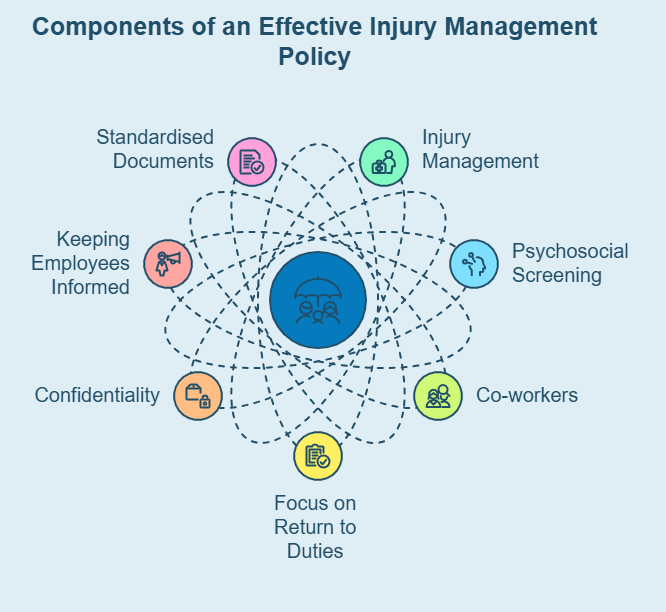
This should include a description of injury management and the processes involved. For example: •define early intervention and timeframes for reporting •provide guidelines for early contact and communication with the employee •outline broad principles around the timing of RTW •describe appropriate RTW duties, and •explain the principles of RTW and injury management. |
Include a clear statement on the organisation's commitment to addressing psychosocial factors that may impact recovery and RTW. Describe: •the chosen psychosocial screening tool •when it will be administered •how screening results will be used to guide interventions, and •guidelines for referral to specialised services based on identified psychosocial risks. |
Acknowledge that RTW is more successful when the employee receives support and cooperation from co-workers. With the employee's permission, co-workers should be informed of the employee's needs and advised about how they can assist in RTW endeavours. |
State the workplace's commitment to providing flexibility and support with RTW duties. Emphasise that continuing work activities, within safe limits, is part of the recovery process. |
Address employee confidentiality issues, including: •how psychosocial screening data will be collected, stored and shared •that hard copy files are kept secure and electronic files are protected. |
Include a statement of intent to inform an employee early on in their claim about things like: •rates of pay and how they change over time •the importance of employee involvement in RTW •how the employee may best influence the situation positively, and •the psychosocial screening process and its purpose. |
Implementing any policy is helped by clarity. Standardised documents or structures can make the job easier to do. Consider including standardised: •RTW plans •letters to doctors and employees •job demands analysis •potential modified duty jobs with accompanying job descriptions •psychosocial screening forms and interpretation guides, and •matched care intervention plans. |
|

