|
<< Click to Display Table of Contents >> The case for early psychosocial intervention |
  
|
|
<< Click to Display Table of Contents >> The case for early psychosocial intervention |
|
Psychosocial factors
Research consistently shows that psychosocial factors are primary drivers of unnecessary disability for common health conditions. For example, a worker may be experiencing heightened worry or anxiety about their situation. This could stem from concerns about their workplace — such as how they'll be received when they return — or from other aspects of their life, like financial pressures or family responsibilities. Some people may doubt their ability to cope with the challenges of returning to work, fearing they won't be able to manage their duties or keep up with expectations.
All of these concerns contribute to what we call distress — a state of emotional difficulty or suffering that can significantly impact recovery and return to work. When we talk about screening for psychosocial factors, we're trying to identify signs of this distress. By recognising these issues early, we can provide appropriate support and interventions to help workers navigate their return to work more successfully.
This approach acknowledges that recovery and return to work involve not just physical healing but also addressing the emotional and practical challenges that workers face during this process.
Psychosocial matched care
Psychosocial matched care is an approach where the level and type of intervention are tailored to the specific needs that have been identified through psychosocial screening. This means that workers receive interventions that are proportional to their level of risk and targeted to their particular psychosocial barriers.
For example, a worker identified as high-risk might receive more intensive support — such as one-on-one counselling — while a lower-risk worker might be provided with self-help resources and periodic check-ins. This tailored approach ensures that resources are used efficiently and workers are supported effectively.
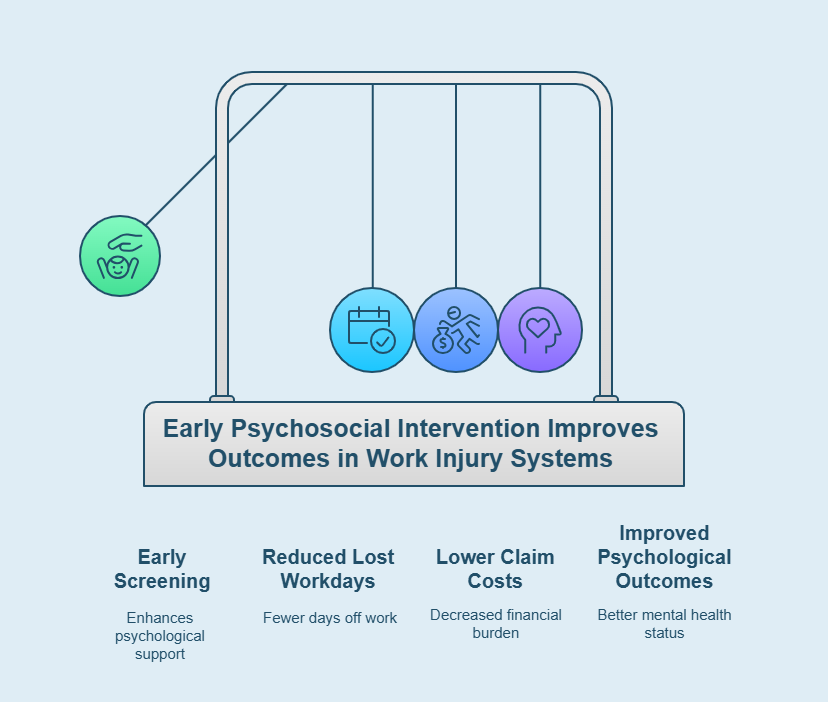
Implementing early psychosocial screening and matched care can lead to significant improvements in RTW outcomes and cost savings for employers and insurers.
tailored to each worker's needs - improving outcomes and reducing costs. |
Key findings from major studies
The Work Injury Screen Early (WISE) study, conducted in Australian public hospitals, demonstrated the effectiveness of early psychosocial screening and intervention:
•Psychological outcomes: The intervention group showed significant improvements in distress, disability and pain self-efficacy.
•Lost workdays: 24 months post-injury the group that received the extra support had less than half the time off work — 32 lost workdays compared to 66 days for the control group.
•Cost savings: At 24 months the group that had extra support’s average claim cost was 30% less than the control group — $16,443 versus $23,405 for the control group.
Similarly, the Early Management of Claims and Psychosocial (EMCAP) study at Australia Post reported:
•a 30% decrease in average claim costs for high-risk workers in the intervention group compared to the control group
•a 44% reduction in incapacity costs and a 17% reduction in healthcare costs for high-risk workers compared to the control group
•a 35% decrease in claims exceeding 30 days off work in the intervention group compared to the control group.
These results demonstrate the potential for early psychosocial screening and matched care to improve outcomes.