|
<< Click to Display Table of Contents >> Understanding psychosocial hazards |
  
|
|
<< Click to Display Table of Contents >> Understanding psychosocial hazards |
|
Psychosocial hazards at work are aspects of work design, organisation and management that have the potential to cause psychological or physical harm. These hazards arise from or relate to:
•the design or management of work
•the working environment
•workplace interactions or behaviours.
Common psychosocial hazards include:
•high job demands
•low job control
•poor support
•lack of role clarity
•poor organisational change management, and
•inadequate reward and recognition.
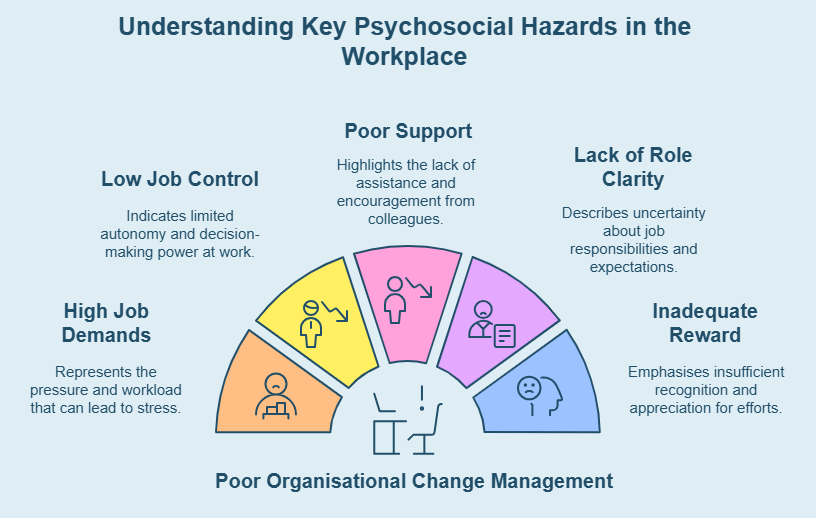
Exposure to psychosocial hazards can lead to work-related stress, which occurs when a worker perceives that the demands of their work exceed their ability or resources to cope. While stress itself is not an injury frequent, prolonged or severe stress can cause both psychological and physical harm. The impact of these hazards can be significant, affecting not only individual workers but also organisational performance and productivity.
Psychosocial hazards can interact or combine, potentially increasing the risk of harm. For example, a worker experiencing high job demands may be at greater risk if they also lack support or have low job control. Employers have a duty under Work Health and Safety laws to manage risks to psychological health just as they do for physical health risks.
The period following a work injury can be particularly challenging for workers, making them more vulnerable to psychosocial hazards. During the RTW process psychosocial hazards may include:
•inadequate communication
•unsuitable work duties
•assigning tasks that are perceived as meaningless, unproductive or misaligned with the worker's capabilities or agreed RTW plan.
|
