|
<< Click to Display Table of Contents >> Committed management: Making the case for best practice RTW |
  
|
|
<< Click to Display Table of Contents >> Committed management: Making the case for best practice RTW |
|
The first step in developing a best practice work disability program is to get commitment from the leaders of the organisation. This may include senior management, leaders from the 'factory floor' and production and HR management.
Getting senior, finance and risk management on side: The financial case
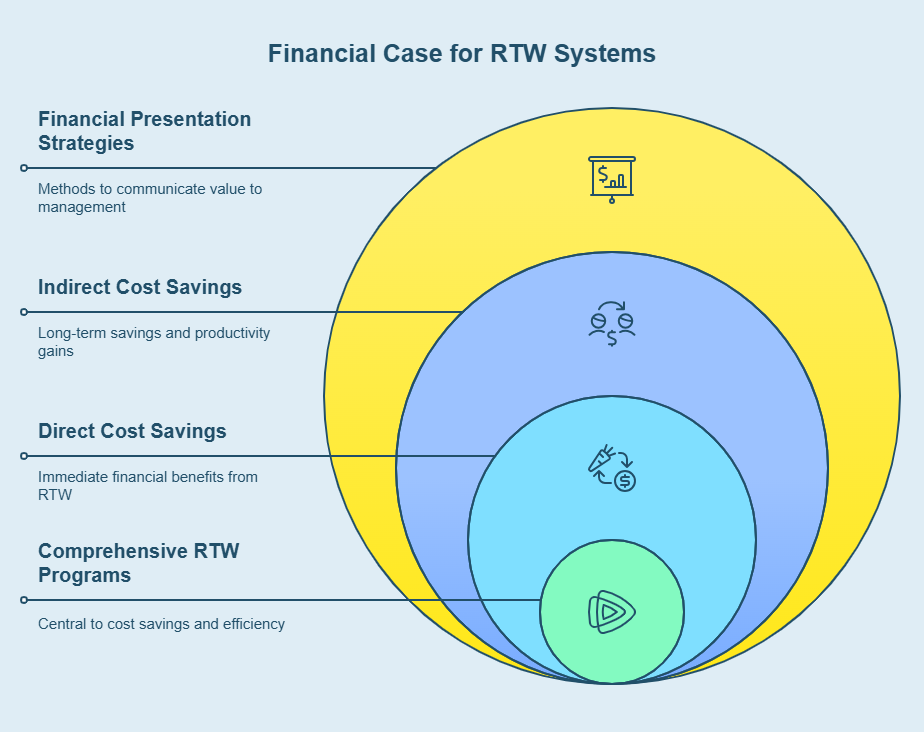
When making the case for best practice RTW systems to senior management the financial argument is often the most compelling. It is important to highlight both the direct and indirect cost savings that can be achieved through implementing comprehensive RTW programs.
Direct costs are those immediately associated with workplace injuries and illnesses. Implementing effective RTW programs can significantly reduce these costs: •Workers' compensation premiums — improved RTW rates and reduced claim durations lead to lower premiums over time. •Medical expenses — early intervention and proper care can prevent complications and reduce overall medical costs. •Wage replacement — faster RTW means fewer days of wage replacement payments. •Legal costs — effective programs can reduce disputes and associated legal expenses. •Administrative costs — streamlined processes can decrease the time and resources spent on claim management. |
Indirect costs, while less obvious, can have a substantial impact on an organisation's bottom line. These costs are often several times higher than direct costs: •Productivity losses — reduced when injured workers return to work more quickly. •Overtime expenses — reduced need for other employees to work extra hours to cover absent workers. •Temporary worker costs — less reliance on temporary staff to fill gaps. •Training costs —decreased expenses for training replacement workers. •Reduced turnover — effective RTW programs can improve employee retention, reducing recruitment and onboarding costs. •Improved morale — better RTW outcomes can boost overall workplace morale, potentially increasing productivity across the organisation. •Enhanced corporate image — a reputation for taking care of employees can attract top talent and improve customer perceptions of the organisation.
|
By presenting a comprehensive financial case that addresses both direct and indirect costs, you can make a compelling argument about the value of investing in best-practice RTW systems. Tailor your presentation to your specific organisation's context and financial priorities. When presenting to senior management, consider these approaches: •Use concrete numbers —provide specific examples of cost savings achieved by similar organisations or from pilot programs in your own company. •Highlight the multiplier effect — emphasise that indirect costs can be 4 to 14 times higher than direct costs, amplifying the potential savings. •Long-term projections — show how investments in RTW programs can lead to cumulative savings over several years. •Benchmark comparisons — compare your organisation's current costs with industry benchmarks to illustrate the potential for improvement. •Case studies — share success stories from other companies that have implemented similar programs. •Risk analysis — demonstrate how effective RTW programs can mitigate financial risks associated with long-term disability claims and legal issues. How cost allocation affects RTW outcomes
|
Making other cases to management
When arguing for best practice RTW systems that incorporate a holistic approach to worker health, there are several other 'cases' that should be put to management:
The ethical case
Organisations have an obligation to support staff with an injury, including addressing all aspects of their wellbeing.
|
The corporate image case
Implementing comprehensive RTW programs that care for mental and emotional well-being can improve an organisation's standing with both employees and the wider community.
The legal case
Many jurisdictions now require employers to consider all workplace hazards and risks, including those affecting mental health. Implementing comprehensive screening and interventions can help meet these obligations.
|
The health and wellbeing case
Addressing all aspects of worker health can lead to better overall outcomes for employees, not just those concerning work injuries.


