|
<< Click to Display Table of Contents >> Healthcare providers as partners in recovery and RTW |
  
|
|
<< Click to Display Table of Contents >> Healthcare providers as partners in recovery and RTW |
|
Healthcare providers are important partners in an injured worker's recovery and RTW journey. Fostering strong relationships with quality providers:
•supports timely, responsive care
•enhances collaboration between all stakeholders
•benefits workers and the workplace
•promotes evidence-based healthcare proactive work injury management.
General Practitioners (GPs) often serve as an injured worker's first point of contact with the healthcare system. They face challenges managing work injuries (including time and financial pressures), lack of training in workers' compensation and difficulties addressing both physical injuries and their psychological toll. To effectively engage with GPs organisations should provide clear information about job duties and accommodations, offer worksite visits and keep GPs updated on the worker’s progress. |
Specialists and allied health professionals can greatly benefit the RTW process. Occupational physicians offer expert opinions on work capacity and restriction. Occupational physiotherapists and exercise physiologists conduct functional evaluations and design work conditioning programs. Psychologists with occupational health experience can address psychological barriers to RTW and provide strategies for managing work-related stress. When building a network of quality providers organisations should look for those who: •have experience and expertise in occupational health and RTW •demonstrate a patient-centred, collaborative approach •are willing to communicate openly with employers and insurers •focus on function and returning to normal activities •base treatment plans on current clinical guidelines. |
Effective communication
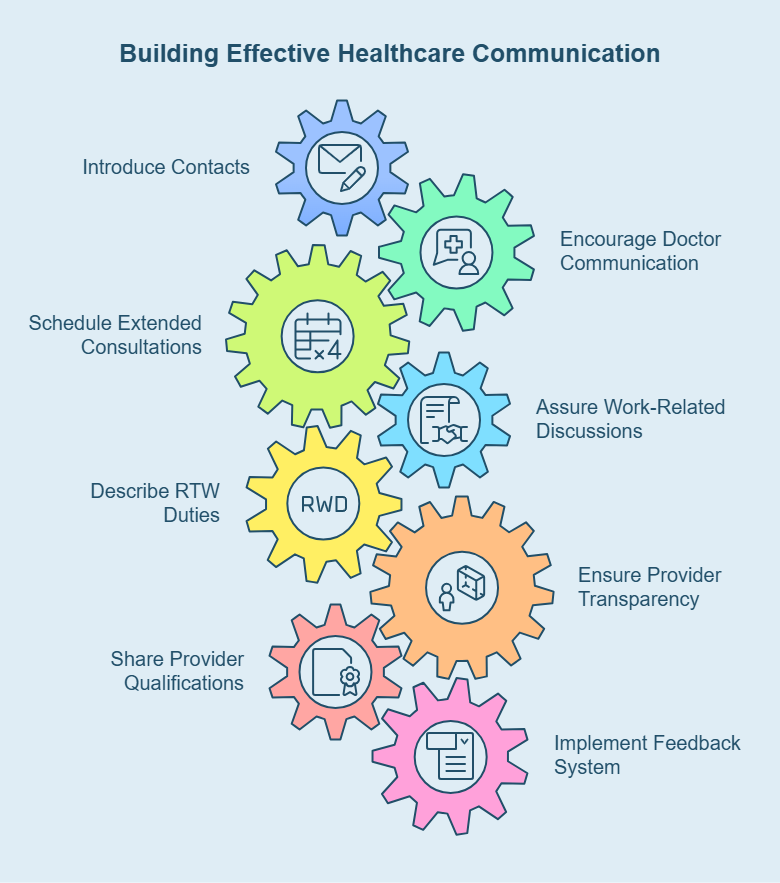
To foster effective communication with healthcare providers organisations can:
•introduce your workplace contact in a concise, professional letter
•encourage workers to tell their doctors about the workplace's willingness to discuss suitable duties
•recommend scheduling extended consultations to enable time for workplace communication
•assure providers that discussions will centre on work-related matters
•Offer clear, detailed descriptions of potential RTW duties.
Building trust in recommended medical practices and stronger, more effective relationships with healthcare providers involves:
•transparency in how providers are selected
•sharing information about providers’ qualifications
•implementing a system for worker feedback
•regularly seeking input from workers and providers
•offering education sessions on RTW processes, and
•considering preferred provider arrangements.